Should you build your own legal AI tools?

What you'll learn:
The three questions I ask before I touch any tool
How to tell when a workflow needs a platform versus a build
Why one of my five Slack channels runs on completely different infrastructure than the other four
With tools like Claude, n8n, Zapier, Lovable, etc. it is possible to build your own legal AI tools and agents.
But do you really want to do that?
Let me compare what I am currently doing on Slack. Currently, I am running 4 Slack channels with Wordsmith and 1 with n8n.
Wordsmith - a legal AI platform that connects to your stack (Slack, Drive, Notion) and answers legal questions in context, with you as the approval gate. You configure it. You don't maintain the plumbing.
n8n - a workflow automation tool. You wire the pipeline yourself: trigger, steps, model call, output. Nothing happens until you build it. Everything is yours to fix when it breaks.
I don't start with the tool. I start with three questions. Every one of these channels began the same way. Not with "what can Wordsmith do" but with a problem someone actually had. Here are the three I'll walk through.
Section 1 — What you're building
First, I always start with a problem that needs to solved. I am going to run through these three examples:
Business needs to confirm terms in contracts. #ask-legal
Answering customer legal and compliance questions related to their worker classification, contract, or termination. #ask-legal
Aligning product features and functionality with legal and compliance requirements. #ask-capabilities
Second, because AI needs context, I look to see whether any of the required information is documented:
Yes - we have folders for executed contracts.
Some - we have some answers but not all and will continue to get new questions.
Some - we need documentation of product features and also legal and compliance requirements.
Third, where is this information located:
In the executed contracts folder in GDrive.
We have the answers scattered in Slack, Notion, Google Documents, and product help pages on Intercom.
We have product related information in various locations and the legal and compliance requirements in various locations.
Section 2 — How you build it
Now, its time to think through the workflow. All three start the same way. Someone asks a question in Slack. The difference is what happens after.
Challenge 1 is a Wordsmith job, and an easy one.
Answering questions from executed contracts is close to a perfect use case. The documentation exists, it lives in one place, and the place is clean. Point the AI at the contracts folder, write specific instructions, and it answers without drama. The only real work is making sure the folder is free of drafts and the instructions are tight. Connect the source, customize the prompt, done.
Challenge 2 is also Wordsmith, but with a layer.
Broader legal and compliance questions take more thought, because the answers live in five places or do not exist yet. So this one needs a documentation loop. When a question comes in that I have to answer myself, the system captures both the question and my answer, so I never answer the same thing twice. The corpus gets better every week without me sitting down to build it. Still a configuration. Just one that compounds.
Challenge 3 is why n8n exists.
This is the hard one, and it is the only one I built from scratch. I am asking the AI to reconcile two sources of truth written for different audiences. Product docs written for engineers. Compliance requirements written for lawyers. Putting those side by side and asking for a single correct answer is the highest hallucination risk of the three, by a wide margin.
So I did not let it answer freely. I built a loop with me in the middle.
The pipeline pulls product and compliance information into a Notion database. I review and approve what lands there. Then when a question comes in on Slack, the answer is pulled from that approved database, not generated fresh against raw docs. And if the question has never been asked before, the pipeline captures the new answer and writes it back into the database for next time.
The database is both the source and the destination. It feeds the answers and it grows from them.
That is not a question-and-answer config. That is pull, gate, answer, capture. A platform reads your documentation. This one builds it, with me as the approval gate on what counts as true.
That is the line that flipped me from configure to build.
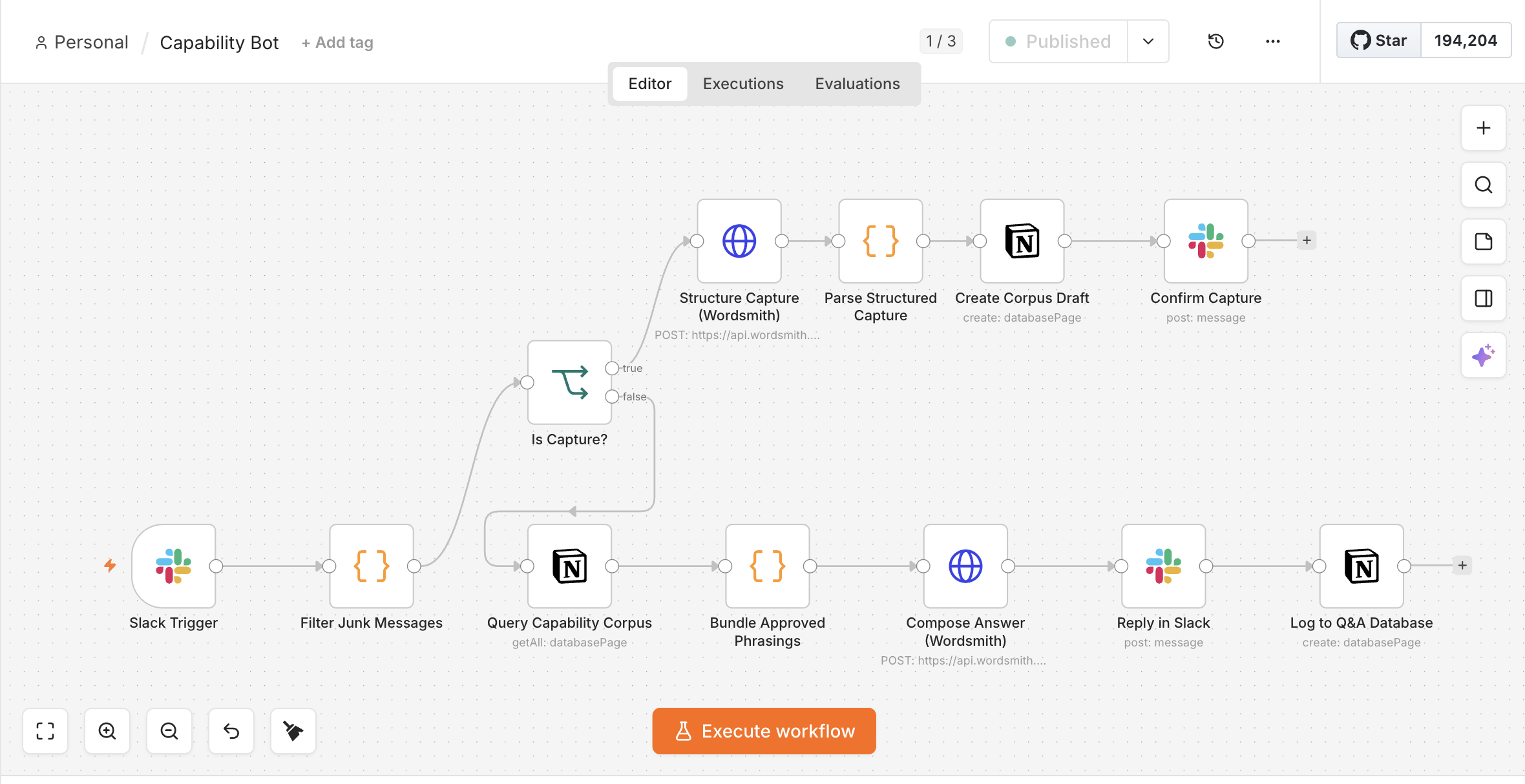
Here is the n8n Workflow.
Section 3 — Wordsmith vs n8n: where they actually differ
Strip away the channels and the real comparison is between building a workflow on a platform and building one yourself. Two things separate them. Setup and responses.
Setup
Wordsmith setup is fast because the hard parts are already built. The Slack connection, the document ingestion, the approval interface, the model calls. I connect a source, write instructions, and I am live in two minutes. The cost is the ceiling. I work inside what the platform decided to ship, and when they ship an update, my configuration can break without me touching anything.
n8n setup is slow because nothing exists until I build it. The trigger, the database read, the model call, the write-back, the error handling for when a step fails at 9pm. Every piece is mine to wire and mine to fix. The cost is time and ownership. The payoff is that the workflow does exactly what I designed, including the things no platform would build for me, like a Notion database that approves and grows itself.
Responses
On Wordsmith, response quality is a function of how clean my source is and how tight my instructions are. Point it at the executed contracts folder and it is excellent, because the source is clean and singular. I also trust Wordsmith more with legal work than the general models because over the last two years, I’ve seen Wordsmith perform at a higher level than Claude and ChatGPT.
On n8n, response quality is a function of the architecture I built around the model. The reason Challenge 3 lives here is due to the complexity of the pull and push of information to various locations. In addition, the responses come from a database I already approved and it pulls the answers verbatim. The build is slower and the maintenance is mine, but the response is grounded in something I verified. In addition, you have control over which LLM you use to process the information. Here I’ve used Wordsmith as the LLM for processing power.
The platform gives you good answers from good documentation. The build lets you engineer what counts as a good answer in the first place.
But if I’m being honest, I built with n8n because I had a more complex workflow than I thought Wordsmith could handle, I wanted more control over the responses, AND I had a hackathon to justify spending an entire day building it out the architecture.
So should you build your own?
The answer is not "build everything," and it is definitely not "buy everything." The build-versus-buy question has an actual answer, and it is sitting in your three questions before you ever open a tool. So in good ol’lawyerly fashion, the answer is “it depends”.
But before you build anything, look hard at one thing - how well resources your ops team is.
How much time do you actually have to: (a) build and (b) maintain this? Because that is the cost nobody quotes you up front.
Wordsmith just works. I configure it, and it runs. n8n does not work like that. It took me a day to figure out the workflow and how to build it. Plus, I am continually tweaking it, updating the custom instructions, and adjusting when something drifts. The answers are clunkier than Wordsmith because I built it. It does not run as cleanly as Wordsmith, and it never will, because the cleanliness was the thing I traded away when I chose to build it myself.
That is the real trade. There is control versus convenience, and ongoing maintenance versus a thing that just works.
So if the documentation exists and lives in one clean place, configure a platform and move on. If the workflow has to pull from multiple sources, then reconcile conflicting sources and write back to the corpus, maybe you want to build it, but go in knowing you have signed up for the upkeep. The build is never done. It is a thing you tend and it may never run as smoothly as a tool like Wordsmith.
And none of this is Slack-specific. Swap Slack for Teams, Drive for SharePoint, Wordsmith for Copilot Studio, n8n for Power Automate. The logos change. The three questions do not.