AI Field Notes from a GC
Weekly observations, real problems, and honest updates from AI educator turned GC building an AI-powered legal function.
This blog is archived
Every post below is still free to read. New writing lives in The Field Guide.

Why I’ve been quiet
A few months ago I stopped posting as much. Field Notes went from weekly to sporadic. LinkedIn went from daily to occasional. If you noticed, you weren’t imagining it. I owe you the real reason, not the vague one.

Should you build your own legal AI tools?
Lovable lets anyone build an app without code. Here's the workflow that actually works, what I built with it, and what the security record means for you.

Before You Build in Lovable, Read This
Everyone's building in Lovable. Most are doing it wrong -- and some are exposed and don't know it yet. Three things to know before you build.

Two can't-miss Claude for Legal events next week
Next week there are two events for in-house lawyers working on AI. One is a live hands-on build session where you'll actually make something useful in under 90 minutes. One is the next in the L Suite Claude for Legal series -- with the full back catalog included when you register. Both are free. Both are designed for every skill level. Here's where to sign up.

I built a legal ops dashboard in Cowork. Here it is.
Last week I presented two live AI legal workflows to the L Suite community. A legal ops dashboard built in Cowork -- now free on GitHub. And a two-pipeline compliance system where AI builds and maintains a Notion corpus of approved product capabilities, and answers Slack questions from it automatically. No lawyer required. The recording is up. The tools are free. Here's everything from the session.

First Look: The workflow I built at a hackathon
A video walkthrough of the workflow I built at Worksome's hackathon using Claude, n8n, Notion, Slack, and Intercom.

The AI Upgrade Tax
I love technology and get jazzed when new features are released. But when frontier models ship new features, the effects don't stop at the frontier. They ripple into every legal AI tool built on top of them. Wordsmith upgraded. The workflow I had built carefully and deliberately quietly stopped working. Nothing was visibly on fire. Everything was just slightly wrong. This is the upgrade tax -- and it has taught me more about AI architecture than anything I planned to build.

The 12 Claude Legal Plugins Explained
Claude for legal plugins get to know you based on your playbook, your approvers, and your house style. Here's what each plugin is for, what the interview asks, and what changes once Claude knows you.

Installing Claude for Legal Plugins
Anthropic launched Claude for Legal — 12 practice-area plugins for in-house teams and law firms. Here's how what they are and how to install them from GitHub today.

From Chat Artifact to Command Center: What Claude Cowork Changes
I built a legal triage dashboard in Claude Chat. It worked well enough as a prototype -- until I realized I was rebuilding the context every single time I opened a new session. My friend Alex showed me what I was actually building and where it belonged. Turns out plugins, connectors, and skills are not the same thing, and knowing the difference changes how you build. This week's Field Notes is the framework. Field Guide members get the live session.

Claude for Word: The Plugin
I have strong opinions about Word plugins. I don't want to use them. So when Claude for Word launched, I assumed whatever they'd built into the plugin would eventually show up in chat too. I decided to test that assumption — no plan, just a horrible document and misplaced confidence. It failed. Badly. And I ran out of credits. The interesting part? The failure was half my fault and half Word's. I went down a rabbit hole trying to understand why, and what I found is genuinely nerdy and worth knowing if you work with documents and AI.

Two Skills + One Automation
A polite f*ck you email skill, an adversarial contract reviewer, and why I keep coming back to the same answer when people ask how to start building with AI.
Two AI skill files for in-house legal teams, a live Salesforce to Wordsmith to Slack automation in progress, and a framework for thinking about where AI actually fits in your legal function. From a GC building this in real time.

Prompts, Custom Instructions, and Skills
I asked my AI to draft a contract. It already knew my company, my format, my risk positions, and what to flag without being told. That's not a prompt. Here's what it actually is.
It's Not the Output. It's the Input.
A federal judge just ruled that privilege didn't protect a defendant's conversations with consumer Claude. Most of the coverage told you what he decided. Almost none of it told you what he left open or where the real risk actually lives. It's not the AI-assisted memo. It's what you fed in to produce it. And if you're using Claude Cowork, there's a second problem that has nothing to do with waiver and everything to do with what happens when you have to defend the privilege in court. I went to Anthropic's own support pages to understand the exposure. What I found should be in every in-house legal team's AI policy.
Claude and Wordsmith Are Making My Dashboard Dreams Come True
I've had dreams of a live, interactive legal dashboard forever. This week I started building it. I'm also covering how I restructured our Google Drive using Claude Cowork and why I never rely on just one AI tool for legal work, including the prompting technique that forces AI to argue against itself.
The File That Is a Game Changer for Claude
AI doesn't know your jurisdiction, your risk tolerance, or your edge cases. A context file fixes that. Here's what's in mine.
AI Legal Triage - 3 Buckets
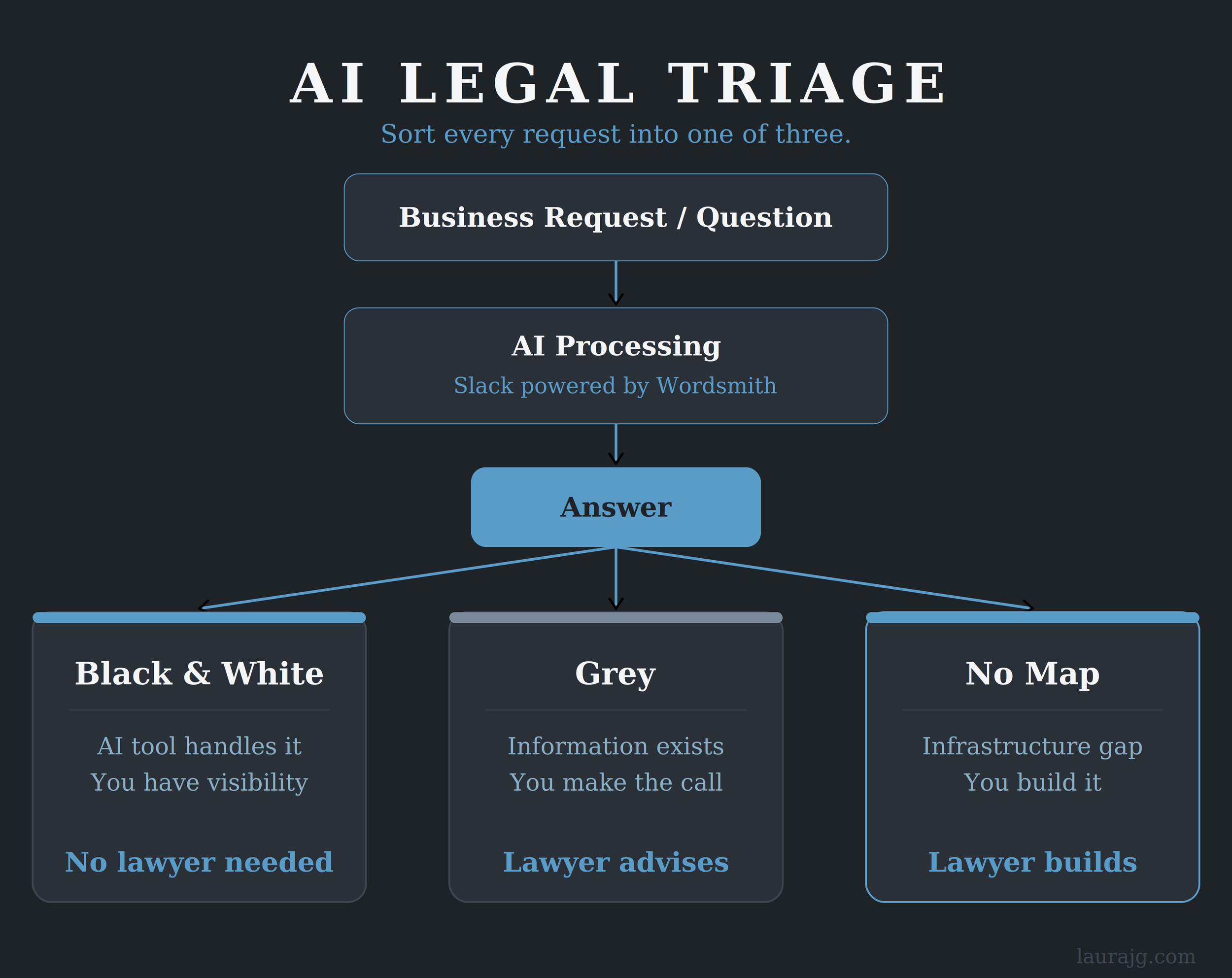
The team was already debating how to respond before I opened Slack. Wordsmith had reviewed the contract overnight. By the time I got there, the business had the information they needed and had already decided to push back. They didn't need me.
That contract showed me something I hadn't fully articulated yet. Every request that comes into legal falls into one of three buckets. Most teams are treating all three the same way.

Context is Everything
I woke up to find Wordsmith had reviewed a contract overnight and flagged it as one-sided and way outside industry standards. The team had already read it. They were already thinking through the implications. Without me. That was the moment I understood what a neutral tool actually does.

Finance Got Lucky. Legal Didn't.
Legal works in the gray. When legal analysis IS binary — is this a contract or not, is this clause standard or not — we're usually not the ones spending time on it. We spend time on the areas that are genuinely contested. The judgment calls. Which is exactly where AI is hardest to verify.

How my brain works — and why it helps me build with AI
I'm a top-down thinker — I start with the answer before I fully understand the question. Turns out that's an advantage when you're building with AI. This is my actual legal intake playbook: how I handle problems when they hit Slack, how I decide between making a call and fixing a process, and the three-step framework I use to get AI doing the heavy lifting on broken workflows.