AI Legal Triage - 3 Buckets
What you'll learn:
Why most legal teams are treating three completely different jobs as one
The three-bucket framework for sorting every request that comes into legal
How AI changes which bucket something lands in and what that means for your time
The Illuminating Example
The team was already debating how to respond before I opened Slack.
Wordsmith had reviewed the contract overnight. Flagged it as one-sided and well outside industry standards. In plain language. Without me.
By the time I got there, the business had already identified the riskiest clauses and decided to push back. They didn't need me. They had the information.
That contract wasn't a grey area. And that's the point.
After six months of running AI through our legal function, I've stopped thinking about requests as "legal questions" and started sorting them differently. Every single thing that comes to me now falls into one of three buckets.
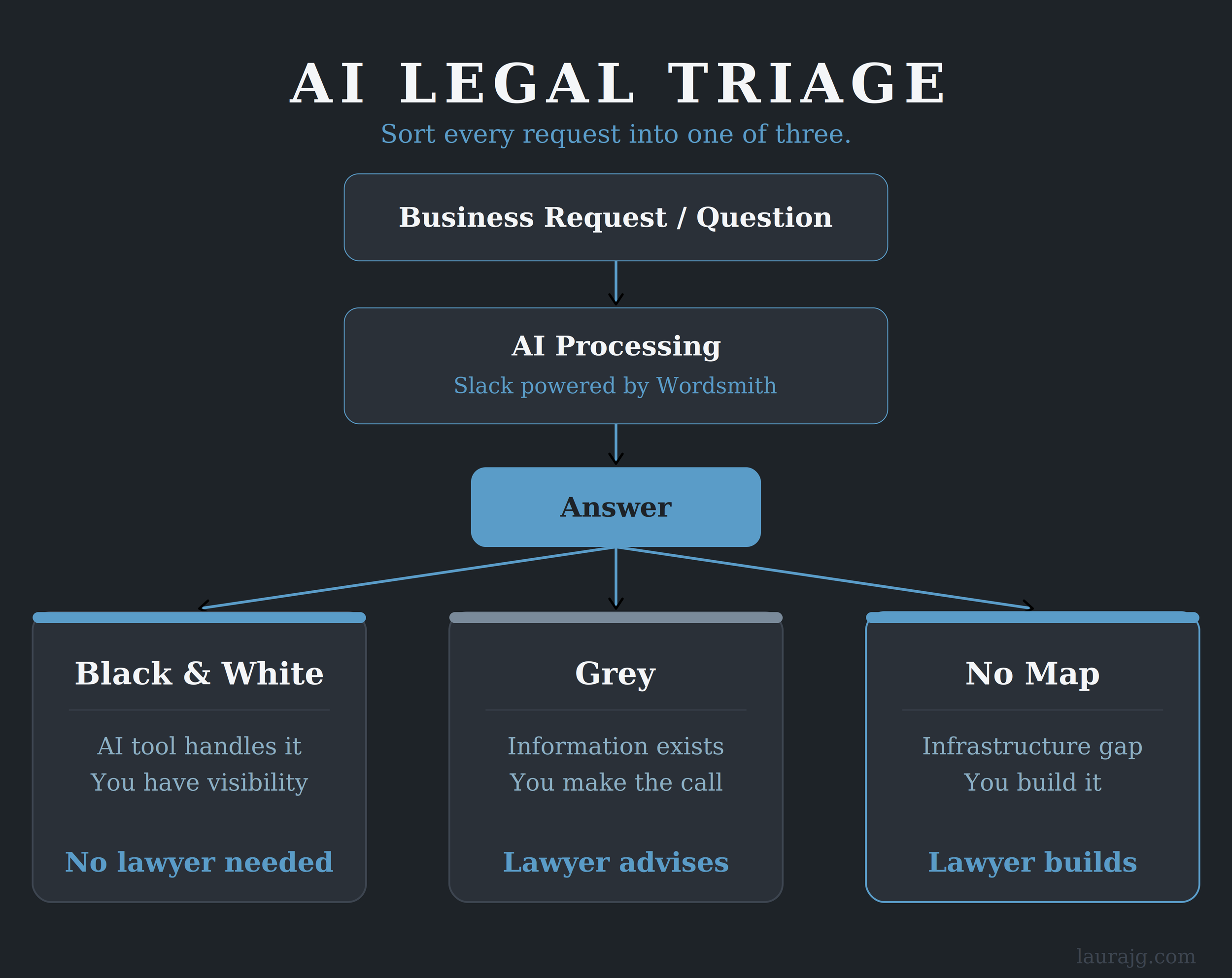
AI Legal Triage Explained
Black and white. The AI tool handles it. The business gets the information they need to make a call without waiting on me. I have visibility, but I don't need to be in the room. The Wordsmith contract review was this. Clear risk flag, clear business decision, no judgment call required from me.
Grey. The information exists. I'm not there to find it — that's what AI does now. I'm there to make a call. Competing risks, business context, legal judgment. The reason the business hired me in the first place. AI makes me better and faster here. It doesn't replace the call.
No map. The question is coming to me because the infrastructure doesn't exist yet. No process, no template, no policy. Or the infrastructure exists and it's broken. I'm there to build something so this question never routes to me again.
Three completely different jobs. Most legal teams are treating all three the same way. Everything gets queued. Everything waits for a lawyer. And most of what's in that queue is black and white masquerading as grey.
The AI didn't just handle a contract. It showed me where my time was actually going.
Here's what I didn't expect: the triage itself became the design problem. Knowing the three categories is straightforward. Building a system that sorts correctly — without me touching every request — is a different challenge entirely.
That's what I built. And that's what the rest of this post covers.
This post continues in The Field Guide. [Subscribe to keep reading →]