Legal AI or General AI?
Neither choice matters first. Before you choose between legal AI (Harvey, Legora, Wordsmith, GC AI, etc.) and general AI (Claude, ChatGPT, Gemini, Copilot, etc.) build the knowledge layer underneath: where your legal knowledge lives, how new information gets captured, and how AI reads it. If the knowledge lives outside the AI, you can swap the AI without losing anything.
Should a legal team buy legal AI or use general AI?
Many teams end up using both. I use Wordsmith, a legal AI, for legal and compliance work, and Claude, a general AI, for questions about our product. They know different things. The tool is the smaller decision. The bigger one is where your knowledge lives.
What is a legal knowledge layer?
It's the documents, decisions and records your AI draws on, kept outside the AI itself. Our VP of engineering put it simply: don't keep the information inside your AI. Keep it somewhere else, and give the AI instructions for how to access it.
How many layers are there?
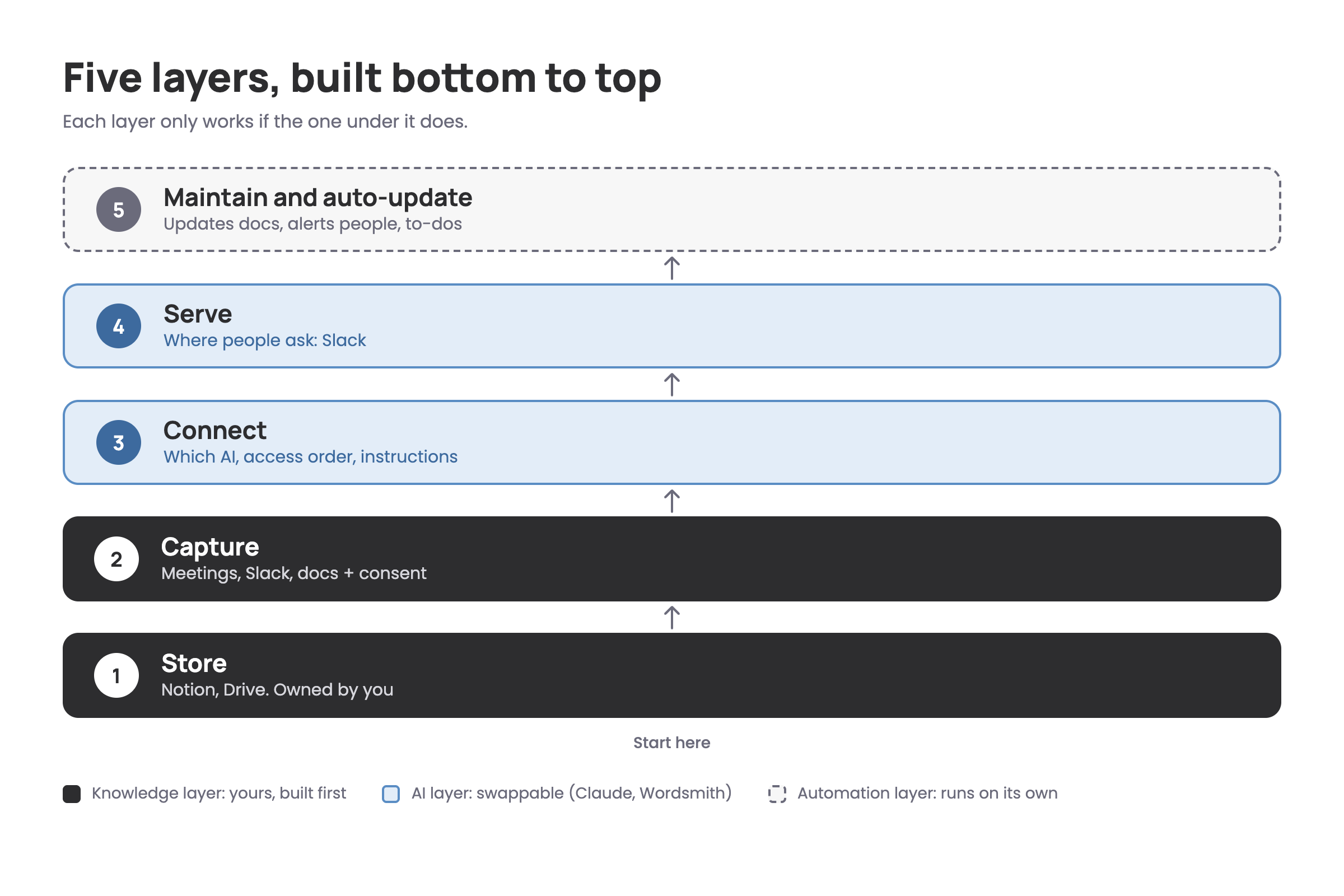
Five, built in order: Store, Capture, Connect, Serve, and Maintain and auto-update. The order matters, because each layer only works if the one under it does.
Why does this matter now?
MIT's Center for Information Systems Research finds that companies still experimenting and piloting AI had financial performance below industry average, while those with AI built into how they work were well above it. Stage three, where scattered experiments become shared infrastructure, is where the work changes. (MIT CISR model)
What's in the full post?
In The Field Guide, I go through the whole setup:
How a new-country worker classification build would run through all five layers
The meeting capture bets we're making, and why consent comes before the tool
What surprised me about Claude, and the question I can't answer yet about legal
Three questions to ask before you pick a tool
Read the full post in The Field Guide ⬇️